Let’s be honest for a second.
Five years ago, most e-sports jerseys looked like someone slapped a logo onto a cycling shirt and called it a day. Loud gradients. Random streaks. That one aggressive lightning bolt everyone thought looked “fast.”
It didn’t.
Now?
Everything’s changed. Quietly. Then suddenly.
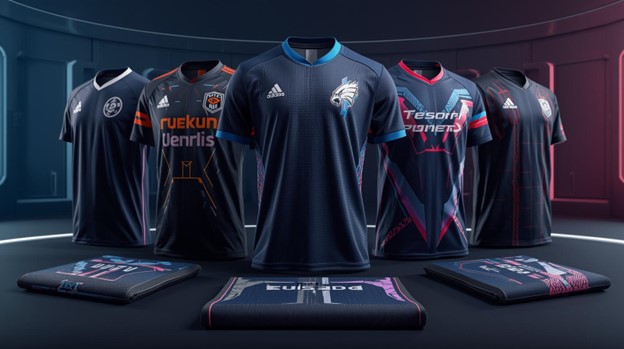
In 2026, e-sports jerseys aren’t just uniforms. They’re statements somewhere between streetwear, digital identity, and performance gear. You don’t just wear one. You inhabit it.
And if you’re in the business of custom sports jerseys, you’ve probably noticed the shift already. If not… you’re late.
The Death of “Generic Gamer” Aesthetics
There was a time when “gamer style” meant neon overload. Purple. Cyan. Black. Repeat.
Done.
Designers got bored. Players did too.
Now the vibe is sharper. More intentional. Sometimes even… restrained. Weird, right?
Instead of shouting, jerseys whisper. Then hit you with one detail that lingers.
A sleeve pattern that only shows under stage lights.
A subtle texture that mimics circuit boards but only if you look close.
Typography that feels pulled from some underground zine in East London.
It’s less “look at me,” more “you’ll notice eventually.”
And that’s exactly why it works.
Streetwear Walked In and Never Left
Here’s the twist no one saw coming: e-sports jerseys started borrowing from streetwear. Then they basically moved in and rearranged the furniture.
Oversized fits. Cropped hems. Unexpected fabrics.
You’ll see a pro player wearing something that could pass for a limited drop from a Tokyo label. And honestly? That’s the point.
Fans don’t just want merch anymore. They want something they’d wear outside a tournament. On a random Tuesday. At a café. Maybe even on a date.
That’s why modern custom NFL team jerseys in the UK are starting to echo this same shift. Clean silhouettes. Fashion-first thinking. Less “sports merch,” more “wearable identity.”
The lines are blurring. Fast.
Fabric Isn’t Boring Anymore
Quick question: when was the last time you cared about what a jersey felt like?
Exactly.
Now designers obsess over it.
We’re talking hybrid materials breathable but structured, soft but somehow crisp. Fabrics that react to light. Panels that stretch in ways that actually make sense for long gaming sessions (because yes, posture matters, even if no one talks about it).
Some jerseys even play with temperature-regulating textiles. Sounds excessive? Maybe. But sit under stage lights for six hours and tell me it doesn’t matter.
Performance used to belong to traditional sports.
Not anymore.
Graphics: Less Noise, More Meaning
There’s a quiet rebellion happening in design studios.
Designers are ditching the chaos. No more throwing ten effects at a jersey and hoping something sticks.
Instead, they’re asking: what does this team actually stand for?
And then building visuals around that.
A team with a tactical playstyle might lean into clean geometry sharp lines, almost surgical.
A chaotic, aggressive squad? Expect asymmetry, broken patterns, something that feels slightly… unstable.
It’s storytelling. Just not the obvious kind.
Even something as niche as a custom hockey jersey from London is starting to reflect this mindset local identity, cultural cues, subtle references that don’t scream but still hit.
Design isn’t decoration anymore. It’s translation.
The Rise of Micro-Details (That Nobody Sees… Until They Do)
This part fascinates me.
Some of the best jerseys in 2026 have details that cameras barely catch. Hidden tags. Inside prints. Stitching choices that only the wearer fully appreciates.
Why?
Because players care.
And fans who buy premium pieces? They care too.
It’s like a secret handshake between designer and wearer.
You don’t show it off. You know it’s there.
And weirdly, that makes it more valuable.
Logos Are Getting… Smaller?
This one’s controversial.
For years, logos were everything. Big. Centered. Impossible to ignore.
Now? Some teams are shrinking them. Moving them off-center. Sometimes even hiding them in plain sight.
It feels risky. Almost wrong.
But here’s the logic: if your brand is strong, you don’t need to shout it.
You can let typography, color, and structure carry the identity.
It’s a confidence move. And when it lands, it lands hard.
Personalization Is No Longer Optional
Let’s not pretend mass-produced jerseys are enough anymore.
Fans want their version. Their name. Their number. Their twist.
And players? They’re pushing even further custom fits, adjusted sleeves, unique patches tied to personal milestones.
This is where custom jerseys uk really take over. Not as a luxury, but as a baseline expectation.
You don’t just buy a jersey.
You co-create it.
That shift changes everything from manufacturing to design timelines to how brands even think about inventory.
It’s messier. But it’s also way more interesting.
Cultural Mashups Are Driving Design
Here’s something I didn’t expect: geography is starting to matter again.
Not in a boring, flag-on-the-sleeve kind of way. More subtle. More layered.
Designers are blending local culture with digital aesthetics. You’ll see patterns inspired by traditional textiles, reimagined through a glitchy, futuristic lens.
A team based in London might pull from underground music scenes. A Nordic squad might lean into minimalism that feels almost architectural.
Even in categories like custom NFL team jerseys in the UK, there’s this quiet fusion happening American sports DNA meeting European design sensibility.
It creates something new. Something that doesn’t feel copied.
Sustainability (Yeah, It’s Finally Real)
I’ll be blunt: for years, “sustainable fashion” in sportswear felt like a marketing checkbox.
Now it’s harder to fake.
Teams are asking questions. Fans too.
Where’s the fabric coming from?
How long will this jersey actually last?
Can it be recycled, or are we just pretending?
Some brands are experimenting with recycled fibers that don’t feel like sandpaper (progress!). Others are producing smaller batches instead of flooding the market.
It’s not perfect. Not even close.
But it’s moving.
So Where Does This Go Next?
Honestly? It gets stranger.
We’re already seeing early experiments with embedded tech nothing too sci-fi yet, but hints are there. Reactive elements. Subtle lighting accents. Materials that shift tone under different conditions.
Will every jersey become a wearable screen? Probably not.
But the boundary between physical and digital identity? That’s getting thinner by the minute.
And e-sports sits right in the middle of that collision.
One Last Thought
Here’s the thing people miss.
A jersey isn’t just fabric. It’s a signal.
It tells you who you are, who you back, and maybe more importantly how you want to be seen.
In 2026, that signal is getting sharper. More personal. Less predictable.
And if you’re creating custom sports jerseys, or experimenting with something like a custom hockey jersey from London, or even rethinking custom NFL team jerseys in the UK, you’re not just designing clothing.